For practitioners in the organic product trade, 2025 marks a critical moment to rethink their strategic layout. Since the EU formally implemented Regulation (EU) 2018/848 (hereinafter referred to as the "848 Regulation") in 2022, the relevant framework has been gradually rolled out in full.
The key milestone that will truly affect exports of organic agricultural products from third countries is 1 January 2025. On this date, the EU will fully shift its oversight of imported organic products from the previous "equivalence system" to "strict compliance".
China has long been one of the EU’s major suppliers of organic agricultural products. Chinese organic goods cover many core categories in the European organic market, including processed vegetables, tropical fruits, honey, nuts, spices and oilseeds.
In 2023, for instance, China exported approximately 13,500 metric tons of organic oilcake to the EU, accounting for more than two-thirds of the EU’s total imports of this product.
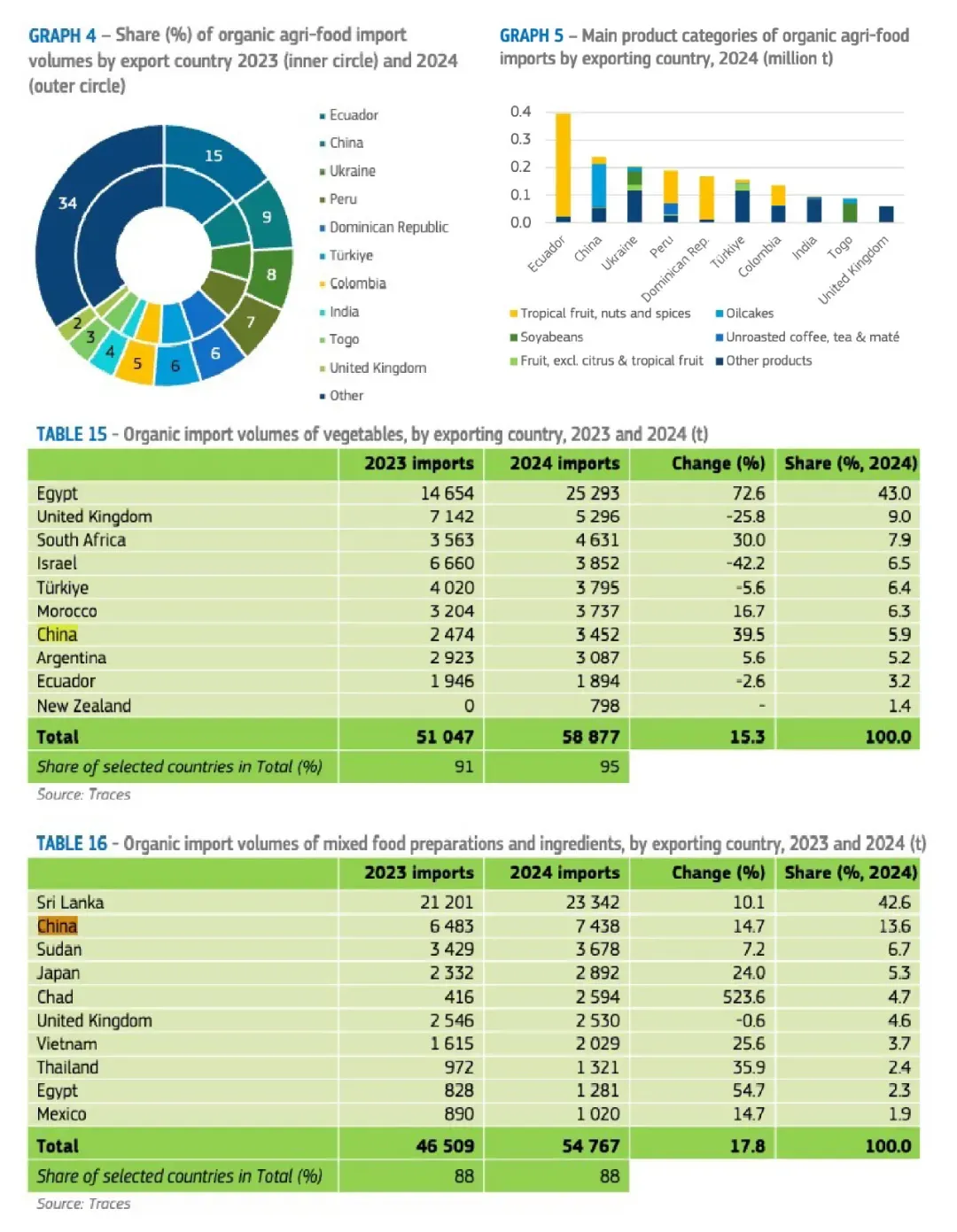
(Source: EU imports of organic agri-food products in 2024, European Commission)
With the entry into force of the new regulation, the original recognition system will be completely revised. Enterprises also need to reinterpret the regulatory logic for accessing the EU market and upgrade their export systems accordingly.Unlike the previous equivalence‑based market access, the 848 Regulation places greater emphasis on genuine compliance throughout the entire production and supply chain. Its underlying objectives are to enhance the credibility of organic trade, prevent fraud, and ensure fair competition within the EU internal market.Against this backdrop, enterprises that fail to adjust their export systems in a timely manner risk goods being detained at ports, loss of certification validity, or even outright rejection of entry.What, then, are the key changes introduced by the 848 Regulation? The following sections provide a systematic overview.
Ⅰ. Shift in the Compliance Model: From "Equivalence" to "Strict Compliance"The most fundamental change under the 848 Regulation is the abolition of “equivalence recognition” for third countries, replaced by a requirement that all imported organic products fully comply with EU standards.Since China has neither signed an organic trade agreement with the EU (e.g., Chile) nor is listed on the equivalence recognition list (e.g., Australia, the United States), all organic products exported from China must undergo certification audits and ongoing supervision by EU‑designated Control Bodies (CBs).
January 1, 2025 marks the cutoff date for the full implementation of the full-chain traceability policy for imported products required by the 848 Regulation.From this point onward, only products with a validated Electronic Certificate of Inspection (e-COI) in the TRACES system will be allowed entry into the EU market.In other words, relying solely on domestic CNAS certification will no longer satisfy EU requirements.Export enterprises must ensure full compliance with EU organic rules across the entire chain — including production, processing, transport and storage.This includes prohibitions on the use of chemically synthesized pesticides, fertilizers and GMOs, as well as the implementation of specific measures for soil protection, animal welfare and biodiversity conservation.
For export enterprises, the implementation of the 848 Regulation mainly brings compliance requirements in three areas:
Carry out full-chain assessment and management — systematically review upstream farms, raw material suppliers and downstream processing stages, conduct comprehensive audits of the production and supply chains, and ensure that at least 95% of product ingredients comply with EU organic standards.Improve management of cooperatives and smallholder groups — especially for cooperatives exporting tea, nuts and other products. The Internal Control System (ICS) must be updated and upgraded, with membership capped at 5,000 people, and the annual random inspection rate increased to at least 5% to meet EU audit requirements.Prepare for strengthened supervision during the transition period — during the 2025 transitional phase, the EU may impose additional official controls and random sampling by product category. If certain Chinese export products are included in the high-risk list (e.g. honey), customs clearance time, inspection frequency and related costs may rise significantly. 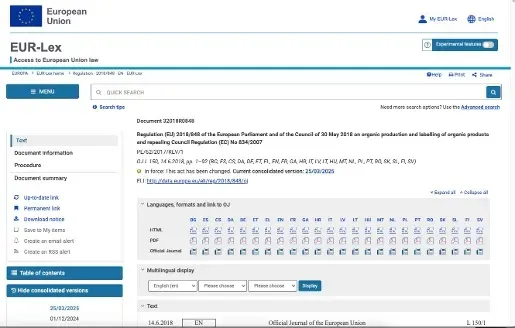
II. Certification and Documentation Requirements: e‑COI and TRACES Are Reshaping the EU Access SystemFrom 2025 onward, the core requirement for accessing the EU organic market will no longer be traditional certification alone, but the ability to successfully register an Electronic Certificate of Inspection (e-COI) via the TRACES system.Issued by EU-approved Control Bodies (CBs), this certificate serves as the sole valid document for customs to verify organic status, acting as a digital entry permit for exporters to the EU market.Any missing documentation, delays, or inconsistent information may directly result in goods being detained at the port or denied entry.Under this system, to ensure the smooth export of organic agricultural products, export enterprises are advised to focus on the following key points:
First
Enterprises must first ensure that their partner certification bodies are listed in the EU’s official recognition scope, such as SRS, ECOCERT and Kiwa, and that regular audits and qualification renewals are completed. The most reliable approach is to cross-verify via the EU Organic Information System (OFIS) to mitigate potential compliance risks.
Second
Enterprises must ensure that all accompanying documents are consistent, clear and traceable, including the EU organic logo code, origin labeling, batch records, and proof of avoiding cross-contamination with non-organic products during processing—all of which are key audit focus areas.
Third
With the full implementation of TRACES electronic systems, enterprises must adjust their operational systems accordingly. Customs declarants, supply chain management teams and certification departments must familiarize themselves with system procedures in advance and establish internal standardized declaration mechanisms to reduce clearance obstacles caused by manual data entry errors. Additionally, in accordance with the EU’s "Working Document on Additional Controls for Third Countries" issued on January 17, 2025, certain Chinese products will also require supplementary declarations of no radioactive contamination risk when submitting e-COI, indicating that document reviews will continue to deepen.
Overall, certification is no longer simply about obtaining a single document.It has become a comprehensive competition centered on data integrity, process transparency, and digital traceability capabilities.Enterprises that take the lead in upgrading their systems and processes will gain greater stability and competitiveness in the compliant EU market environment going forward.III. Agricultural Cooperatives and Group Certification: Key Pressure Points and Structural Opportunities in China’s Export SystemAgricultural cooperatives remain central to China’s organic export structure, covering key products such as Yunnan Pu’er tea, Xinjiang cotton, nuts, and spices.Following the implementation of the 848 Regulation, this production model faces the most direct challenges.The new rules no longer focus only on the final product, but require groups to establish a mature Internal Control System (ICS) covering monitoring, record-keeping, risk assessment, and annual audits.Research by FiBL and IFOAM shows that approximately 2,000 producer groups from third countries worldwide need to complete system upgrades by 2025, or face the real risk of losing EU market access.For smallholders and cooperatives in China, the main challenges lie in three areas:rising certification and supervision costs (estimated to increase by 20%–30%), insufficient training coverage, and limited digital record-keeping capacity.At the same time, with membership capped at 5,000 people and the annual random inspection rate raised to at least 5%, organizational governance will become a critical threshold for EU market access.Yet these pressures also represent strategic opportunities.More transparent and standardized group structures help improve product premium potential, brand credibility, and international negotiating power.Enterprises can accelerate the transition by introducing professional training systems, building digital traceability tools, and participating in capacity-building programs by IFOAM or FiBL.Cooperation with importers, industry associations, or sustainable trade platforms can also help domestic cooperatives access proven compliance frameworks and operational experience, as demonstrated by export models such as Dominican bananas and Peruvian coffee.From a market perspective, EU demand for organic nuts, tea, plant-based proteins, and processed vegetables continues to grow steadily.In 2023, EU imports of organic nuts and processed vegetables reached around 15,000 tonnes and 13,300 tonnes respectively.For Chinese exporters, this means that once agricultural cooperatives establish robust governance and traceability systems, these products will not only be marketable but can also achieve higher prices by communicating their origin stories and sustainable value. Conclusion: Coexistence of Opportunities and Challenges
As Regulation (EU) 2018/848 enters the full implementation phase, the export of organic products is shifting from the previous scale-based competition to a comprehensive competition focusing on quality, transparency, and sustainability. For export-oriented enterprises, this not only means short-term institutional adjustments and increased operational costs, but also may become an important opportunity to form differentiated advantages in the future.
At the same time, the new regulations bring not only an increase in requirements but also a substantive shift in the focus of supervision. Hundreds of pages of implementation rules have extended from agricultural inputs and production processing to labeling, logistics, and market access, significantly increasing the complexity of compliance; the EU's supervision over fraud and pollution incidents has also been further tightened. According to the 2024 EU Market Report, violations involving organic products from third countries account for approximately 30% of all reported cases, among which batches of Chinese honey, vegetable oil, and some teas have been named. This clearly indicates that compliance at a single node is no longer sufficient to resist systemic risks. Uncertainties at the supply chain level also deserve vigilance — since the implementation of "additional official controls" in 2025, the frequency of port inspections may increase, leading to longer customs clearance cycles and higher logistics and inventory costs. The industry generally estimates that the cost will rise by 10%–15%.
Against this backdrop, the more critical question for exporting enterprises is not whether to adjust, but how to take immediate action: including verifying the qualifications of certificate-issuing bodies as soon as possible, conducting self-inspections of key pollution sources, establishing a traceability data sharing mechanism with EU importers, and continuously monitoring updates to EU delegated regulations and labeling rules. Enterprises that can complete these underlying constructions by 2025 will be more likely to obtain stable orders, higher premiums, and stronger bargaining power in the EU market. From a strategic layout perspective, the appropriate introduction of diversified certification systems such as the US NOP or Japan JAS will help enhance resilience. However, in terms of demand scale, price space, and brand recognition, the EU should still be the priority market for China's organic exports.
In the final analysis, under the new regulatory environment, competition no longer depends on price or output, but on compliance capabilities, operational transparency, and supply chain governance levels. Enterprises that integrate compliance into their daily management systems will not only be able to stabilize or even expand their market share in the EU, but also gain a more favorable position in the construction of global green supply chains. Strictly complying with regulations is not only about market access, but also about long-term brand reputation and consumer trust. It is recommended that exporters continuously pay attention to resources from institutions such as the official website of the European Commission's Directorate-General for Agriculture (agriculture.ec.europa.eu) and IFOAM, and make advance planning and proactive layout.
References
https://agriculture.ec.europa.eu/system/files/2025-05/analytical-brief-7-eu-organic-imports-brief_en.pdf
https://food.ec.europa.eu/horizontal-topics/traces_en
https://eur-lex.europa.eu/legal-content/EN/TXT/uri=CELEX:32018R0848